TESA Treatment in India: Expert Testicular Sperm Retrieval at Delhi IVF and Fertility Research Centre

For many men, hearing the words “no sperm found” during a semen analysis can feel devastating. But azoospermia does not always mean biological fatherhood is impossible. In many cases, sperm may still be present inside the testicular tissue even when none appears in the ejaculate. Advanced surgical sperm retrieval techniques now allow fertility specialists to access these sperm directly and use them successfully in IVF and ICSI treatment.

TESA (Testicular Sperm Aspiration) is one of the most effective minimally invasive sperm retrieval procedures used for men with non-obstructive azoospermia and complex male infertility conditions. By retrieving sperm directly from the testes, TESA offers hope to couples who were once told conception may not be possible. Combined with modern ICSI technology, even a very small number of retrieved sperm can help create healthy embryos and achieve pregnancy.

At Delhi IVF and Fertility Research Centre, TESA procedures are performed by an experienced fertility and embryology team with decades of expertise in male infertility treatment. With advanced laboratory support, real-time sperm assessment, and personalised fertility planning, the centre helps couples navigate even the most challenging azoospermia cases with clarity, compassion, and scientific precision.

CTA Block Background Image - 6a05e659ff967f7763857edb

Advanced TESA Treatment for Male Infertility

Find Hidden Sperm with Precision Testicular Retrieval

Even when no sperm appears in semen analysis, viable sperm may still exist inside the testes. Advanced TESA treatment at Delhi IVF helps retrieve sperm directly from testicular tissue for use in IVF-ICSI treatment.

Call Now: +91-9810600235

What is TESA?

TESA stands for Testicular Sperm Aspiration.

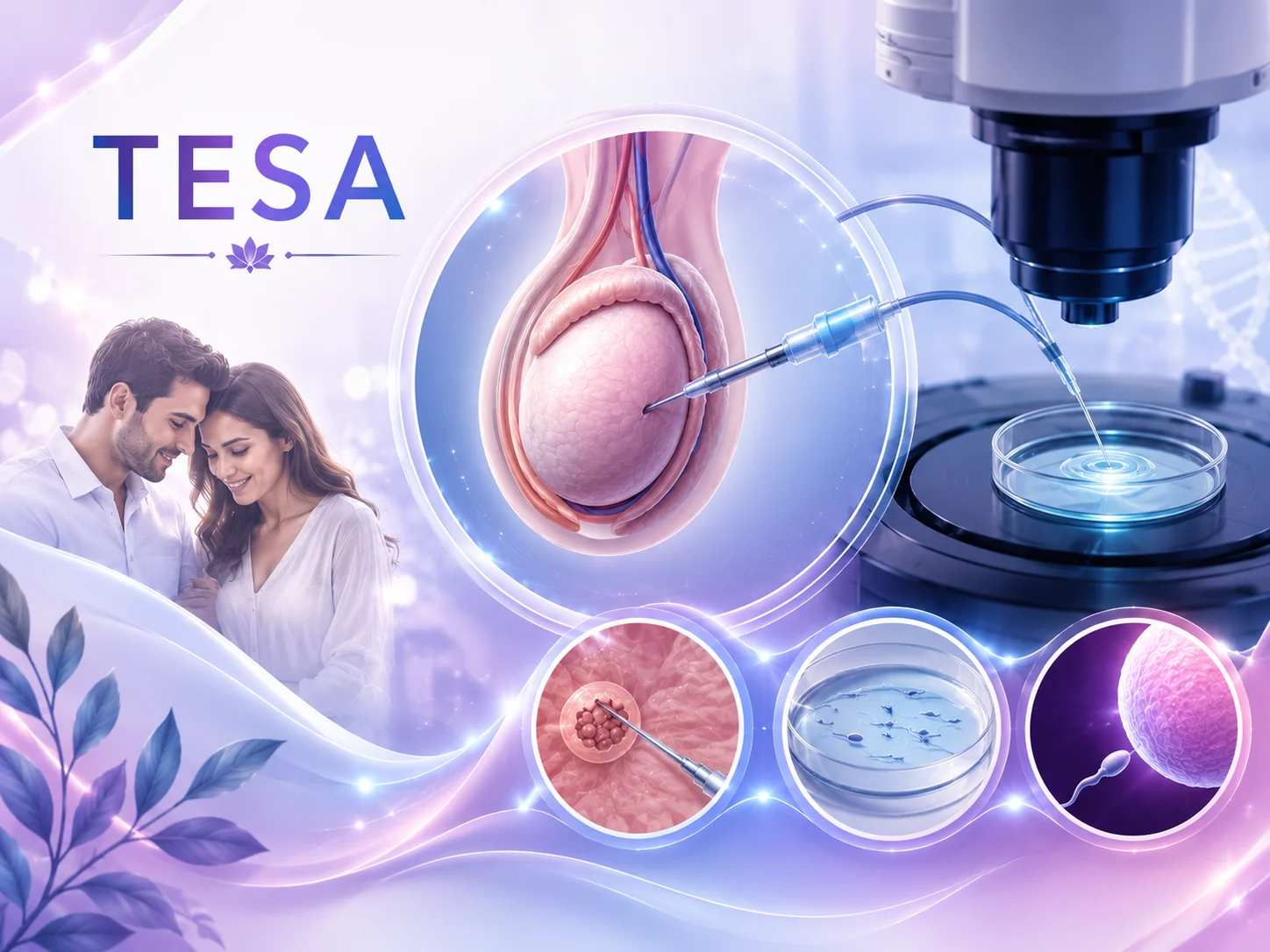
In TESA, a fine needle is inserted directly through the skin of the scrotum into the testis. Gentle suction aspirates a small amount of testicular tissue and fluid. This sample is immediately examined in the embryology laboratory for the presence of sperm.

Think of it like checking the library directly for a book that never made it to the front desk. The sperm may exist inside the testis even when none reaches the ejaculate. TESA goes directly to the source.

Unlike PESA and MESA, which retrieve from the epididymis, TESA retrieves from the testis itself. This makes it appropriate when the problem is with sperm production rather than a blockage.

TESA is performed under local anaesthesia or mild sedation. It takes 20 to 30 minutes. Most men return home the same day.

Content Block Image - 6a060918ff967f7763858ab0

TESA vs PESA vs MESA: Understanding the Difference

Men with azoospermia often encounter these three terms and need to understand which applies to them.

PESA (Percutaneous Epididymal Sperm Aspiration):

Retrieves sperm from the epididymis using a needle through the skin. It is the least invasive option and is used for obstructive azoospermia when a blockage prevents sperm from reaching the ejaculate. Sperm production in the testis is normal.

MESA (Microsurgical Epididymal Sperm Aspiration): Also retrieves from the epididymis but uses a surgical microscope for greater precision and higher yield. Preferred for obstructive azoospermia when large quantities of sperm need to be banked for multiple future ICSI cycles.

TESA (Testicular Sperm Aspiration): Retrieves sperm directly from the testis. Used when sperm is not available in the epididymis or when the cause of azoospermia is non-obstructive. Sperm from TESA is generally less mature than epididymal sperm but can fertilise eggs effectively through ICSI.

The key difference is location. PESA and MESA access the epididymis. TESA accesses the testis. Your specialist at Delhi IVF will determine the right choice through thorough investigation.

Who is TESA Recommended For?

TESA is recommended when sperm cannot be retrieved from the epididymis or when the cause of azoospermia is non-obstructive.

Conditions Where TESA is Used

Non-Obstructive Azoospermia (NOA): Non-obstructive azoospermia means the testes are producing little or no sperm due to a production problem rather than a blockage. Causes include hormonal imbalances, genetic conditions such as Klinefelter syndrome or Y-chromosome microdeletions, previous chemotherapy or radiation, varicocele, undescended testes in childhood, or unknown causes. Even in men with severely reduced production, small pockets of active sperm production may still exist within the testicular tissue. TESA searches for these pockets.

Failed PESA: If PESA did not retrieve sperm from the epididymis, TESA can be performed in the same sitting or in a subsequent procedure to search for sperm directly within the testis.

Obstructive Azoospermia When Epididymal Retrieval is Not Possible: In some cases, scarring or previous surgery makes epididymal access difficult. TESA provides an alternative by going directly into the testis.

Men with a Previous History of Chemotherapy or Radiation: Cancer treatment can significantly reduce sperm production. In some men, partial recovery occurs over time. TESA can assess whether viable sperm still exists, even years after treatment.

Genetic Conditions Affecting Sperm Production: Klinefelter syndrome (47, XXY), Y-chromosome microdeletions, and other genetic conditions can cause severely reduced testicular sperm production. In some cases, small areas of active sperm production persist within the testis. TESA may find these areas. However, genetic counselling is strongly recommended before proceeding, as some conditions carry a risk of being passed to the child.

An Important Consideration for Non-Obstructive Azoospermia

It is important to set honest expectations for men with non-obstructive azoospermia. TESA does not guarantee sperm will be found. In cases of non-obstructive azoospermia, sperm retrieval rates are lower than in obstructive cases: approximately 30% to 60%, depending on the underlying cause. Your specialist at Delhi IVF will discuss the realistic likelihood of finding sperm based on your specific diagnosis before the procedure.

The TESA Process at Delhi IVF: Step by Step

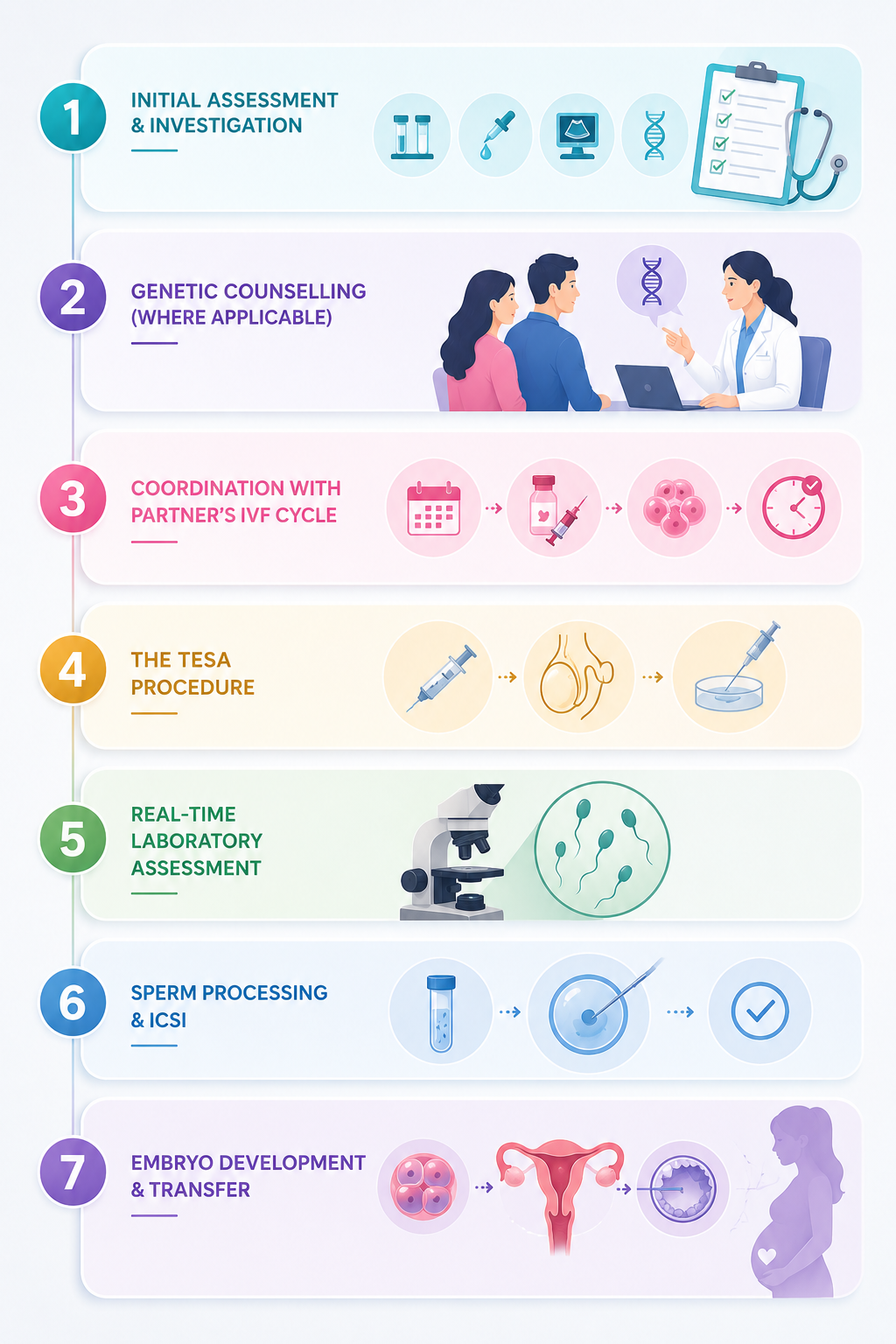
Step 1: Initial Assessment and Investigation

Your first appointment includes a full review of semen analysis, hormone blood tests (FSH, LH, testosterone, prolactin, inhibin B), scrotal ultrasound, and detailed medical history. Genetic testing including karyotype and Y-chromosome microdeletion analysis is strongly recommended before TESA. These determine the likely cause, the probability of finding sperm, and any genetic factors affecting a future child.

Step 2: Genetic Counselling (Where Applicable)

For men with identified genetic causes such as Klinefelter syndrome or Y-chromosome microdeletions, genetic counselling is arranged before proceeding. This allows couples to understand the implications for themselves and any future child before making their decision.

Step 3: Coordination with the Female Partner's Cycle

TESA is ideally coordinated with the female partner's IVF stimulation cycle so that retrieved sperm can be used fresh on the day of egg retrieval. A diagnostic TESA can also be performed in advance to confirm sperm presence before committing the female partner to a full IVF cycle.

Step 4: The TESA Procedure

Under local anaesthesia or mild sedation, the scrotal skin is cleaned, the testis stabilised, and a fine needle inserted into the testicular tissue. Gentle aspiration draws out a small sample, immediately handed to our embryology team.

Step 5: Real-Time Laboratory Assessment

Our embryologist examines the aspirated sample under a microscope immediately. If sperm is found, the result is communicated to the surgeon and collection continues. If the first site does not yield sperm, the needle is repositioned and the procedure repeated at a different location within the same testis or in the other testis. Multiple aspirations may be performed in the same sitting.

Step 6: Sperm Processing and ICSI

Any retrieved sperm is processed in our andrology laboratory. Motile sperm is selected and used for ICSI. A single sperm is injected into each mature egg. Fertilisation results are confirmed the following morning.

Step 7: Embryo Development and Transfer

Embryos develop over three to five days. The best quality embryo is selected for transfer. The pregnancy blood test is done 14 days after transfer.

Content Block Image - 6a05e91dff967f7763857f6d
CTA Block Background Image - 6a05e55cff967f7763857df8

Hope for Men with Azoospermia

Take the Next Step Toward Biological Parenthood

Men diagnosed with obstructive or non-obstructive azoospermia may still achieve pregnancy through advanced sperm retrieval procedures such as TESA, PESA, and MESA combined with ICSI treatment.

Speak with Our Male Fertility Experts: +91-9810600235

TESA Success Rates

Success for TESA depends on two separate outcomes: whether sperm is found, and then the success of the ICSI cycle.

Sperm retrieval rate:

  1. Obstructive azoospermia: approximately 80% to 90% retrieval success
  2. Non-obstructive azoospermia: approximately 30% to 60% retrieval success, depending on the underlying cause

The cause of azoospermia is the most important predictor of retrieval success. Men with hormonal causes of non-obstructive azoospermia tend to have better retrieval rates than those with genetic causes. Your specialist at Delhi IVF will give you a personalised estimate based on your specific investigations.

ICSI pregnancy rate after TESA: Once sperm is successfully retrieved, pregnancy rates follow standard ICSI outcomes: approximately 40% to 50% per cycle for women under 35, declining with age.

TESA Cost in India

In India, TESA is performed as part of an overall ICSI treatment package. The procedure typically costs between Rs 15,000 and Rs 30,000 as an additional charge on top of the base IVF and ICSI cycle.

At Delhi IVF, all costs are explained clearly before your procedure with no unexpected charges.

Real Families. Real Stories.

Our Team

Meet the specialists behind your baby dream

Senior IVF consultants, embryologists and gynaecologists working as one team.

Browse All Our Specialists
Dr. Anoop Gupta

Dr. Anoop Gupta

Director & IVF Specialist, Delhi IVF & Fertility Research Centre

⭐34+ Years Experience
View Profile
Dr. Aastha Gupta

Dr. Aastha Gupta

Infertility Specialist, Obs & Gynae (Gold Medalist)

⭐15+ Years Experience
View Profile
Mrs. Alka Gupta

Mrs. Alka Gupta

Chief Embryologist, Delhi IVF & Fertility Research Centre

⭐32+ Years Experience
View Profile
Dr. Mannan Gupta

Dr. Mannan Gupta

MBBS & MS – Obstetrics & Gynaecology, Maulana Azad Medical College

⭐10+ Years Experience
View Profile
Dr. Vinnie Sandhu

Dr. Vinnie Sandhu

MD (Moscow), Obstetrics & Gynaecology

⭐30+ Years Experience
View Profile

Why Patients Choose Delhi IVF for TESA

Dr. Anoop Gupta, Director and IVF Specialist has 34+ years of experience including extensive work with non-obstructive azoospermia, one of the most challenging presentations in male fertility. His team delivered Delhi's first ICSI baby in 1996 using surgically retrieved sperm.

Mrs. Alka Gupta, Chief Embryologist with 32 years of experience leads the real-time assessment of TESA samples during the procedure. In non-obstructive azoospermia, sperm may exist in very small numbers. Finding them requires exceptional skill under the microscope. Her expertise directly determines whether a successful ICSI cycle is possible.

What our patients experience at Delhi IVF:

  1. Complete male fertility programme covering PESA, MESA, TESA, and TESE under one roof
  2. Real-time embryologist assessment during every TESA procedure
  3. Diagnostic TESA option available before committing the female partner to a full IVF cycle
  4. Sperm freezing facility for banking any retrieved sperm for future cycles
  5. 25,000+ successful deliveries since 1993
  6. Patients from 66+ countries including many referred for complex non-obstructive azoospermia cases
  7. Genetic counselling support for men with identified genetic causes of azoospermia

Our Success Stories

25000 Happy Couples with real stories from Delhi IVF Patients,

google logo
4.5
/5
Based on 1000+ reviews

What our patient's are saying

Updated recently • Verified reviews

I am very happy with my wife by listening news of getting 2 babies in womb after ultrasound. Some time ago we were panicked but now we are very happy. Its a great news for us. We are thankful to Delhi IVF & Fertility Centre.

Manish Gupta
IVF with ICSI

I am so happy to share that my IVF result came positive. Thank you Delhi IVF and Dr Anoop Gupta and Dr Aastha Gupta. The team here is amazing very professional, kind and encouraging. Thank you for giving us hope and happiness truly the best clinic for IVF.

Deepa Kumari
IVF with ICSI

Started with great first initial virtual with Dr Anoop Gupta ,Dr Aastha and team especially Beautiful Preeti ,explained everything perfectly with clear cost of treatment and services provided .Managed to come to the Centre from London in December greeted with nice supportive staff team ,as we had limited time ,all the tests and treatment started quite quickly and continued nicely till the end of.Very impressive experience to be here and feel blessed already Thank you for everything

Navneet Kaur
IUI Procedure

Delhi IVF is the most trusted place, Dr. Anoop Gupta and team, as well as all the staffs are very kind and knowledgeable. Thank you! I got pregnant at first try. I am very happy now. I don't get word to express my feelings and how thankful I am for all Delhi IVF Doctors and staffs.Thank you again.

Angle Thar
Egg Freezing

We are so happy to share that after trying from 11 years we conceived from Delhi IVF in first cycle I am very happy I work in TV9 as a journalist and I came here through reference and then first IVF successful with twins I will recommend everyone to come here for any problem with conceiving.

Rohit Nirwal
IVF with ICSI

Today was my first visit to Delhi IVF centre in srinagar and i felt very good after coming here.The treatment was excellent.I want to tell everyone that if there is any good IVF centre in kashmir.it is only one Delhi IVF centre where Dr.Anoop Gupta provides treatment thank you so much.

Manzoor Paul
IVF with ICSI

My partner and I highly recommend the Dr. Anoop Gupta & his clinic Delhi IVF & fertility centre!!! Our experience was absolutely fantastic; the nurses are very kind, helpful and extremely talented across the whole range from doctors, nurses, and administrators.

Baabul Kumar
IVF with ICSI

I am very happy and my experience with Delhi IVF center is very nice. Now I'll get my 2 baby from the treatment in Delhi IVF. Very good and helpful staff. And I have no words for Dr. Anoop Gupta, he is very kind and well caring.Thank you Dr. Gupta and all staff members.

Ravi Prakash
IVF with ICSI

It's an amazing IVF centre, all doctors and staff are very supportive. We have been trying since a very long time, finally got success, all thanks to Delhi IVF.

Kundan Sinha
Egg Freezing

Very good experience after visiting and meeting with Dr. Anoop gupta ji and his team. Before visiting here we had lost all hopes of conceiving baby but here we got confidance again and successfully gives birth to beautiful princess.

Dinesh Chauhan
IVF with ICSI

I am short of words when it comes to thanking Delhi IVF for what it has given me. I had been trying for 8 yrs and this clinic has given me the best gift ever. The team of doctors led by Dr Gupta and Dr Vinny are very helpful and caring.

Anubha Singh
IVF with ICSI

Dr Gupta is an amazing doctor. I strongly advise to all friends and family who are struggling to become parents. You are assured to have a very satisfying experience and you could faith him fully to make the best result for you.

Rohit Lakra
IVF with ICSI

I am very happy with my wife by listening news of getting 2 babies in womb after ultrasound. Some time ago we were panicked but now we are very happy. Its a great news for us. We are thankful to Delhi IVF & Fertility Centre.

Manish Gupta
IVF with ICSI

I am so happy to share that my IVF result came positive. Thank you Delhi IVF and Dr Anoop Gupta and Dr Aastha Gupta. The team here is amazing very professional, kind and encouraging. Thank you for giving us hope and happiness truly the best clinic for IVF.

Deepa Kumari
IVF with ICSI

Frequently Asked Questions

Q1: What is TESA treatment and how does it work?

TESA (Testicular Sperm Aspiration) retrieves sperm directly from the testis using a fine needle. A small amount of testicular tissue and fluid is aspirated and examined for sperm. Retrieved sperm is used with ICSI to fertilise eggs. It is used for both obstructive and non-obstructive azoospermia.

Q2: What is the difference between TESA and TESE?

TESA uses a fine needle to aspirate sperm and tissue from the testis. TESE involves a small surgical incision to remove testicular tissue directly. TESE is more invasive but can access areas a needle may miss. Your specialist at Delhi IVF will advise which procedure is appropriate based on your diagnosis and previous results.

Q3: What is the success rate of TESA for non-obstructive azoospermia?

For non-obstructive azoospermia, TESA retrieves sperm in approximately 30% to 60% of cases depending on the underlying cause. Hormonal causes tend to have better outcomes than genetic ones. For obstructive azoospermia, success rates are higher at 80% to 90%. Your Delhi IVF specialist will estimate your likelihood based on investigations.

Q4: How much does TESA cost in India?

TESA in India typically costs between Rs 15,000 and Rs 30,000 as an addition to the base ICSI cycle. Total treatment cost includes the female partner's IVF cycle, ICSI, sperm retrieval, and embryo transfer. Sperm freezing and storage are charged separately. Delhi IVF provides transparent pricing before your procedure begins.

Q5: Can TESA be done for men with Klinefelter syndrome?

Yes. TESA can be attempted for men with Klinefelter syndrome (47, XXY), where some areas of active sperm production may still exist in the testis. However, retrieval rates are lower than in hormonal causes of azoospermia. Genetic counselling is strongly recommended before proceeding, as the condition may carry implications for the child.

Q6: Should a diagnostic TESA be done before the female partner starts IVF?

In cases where it is uncertain whether sperm will be found, a diagnostic TESA before the female partner begins IVF stimulation is sensible. It confirms whether viable sperm exists before committing to a full, expensive IVF cycle. Your specialist at Delhi IVF will advise whether this is the right approach for your situation.

Q7: Is TESA painful?

TESA is performed under local anaesthesia or mild sedation, so discomfort during the procedure is minimal. Mild testicular aching and tenderness are expected for two to three days afterwards. Most men manage with standard pain relief and return to light activities within two to three days of the procedure.

Q8: Can sperm retrieved through TESA be frozen for future ICSI cycles?

Yes. Any sperm retrieved through TESA that is not used immediately can be frozen and stored for future ICSI cycles. This is especially valuable for men with non-obstructive azoospermia, where repeating the retrieval procedure does not guarantee finding sperm again. Frozen samples provide a reliable backup for future attempts.

Q9: Can TESA be performed after failed PESA or MESA?

Yes. If PESA or MESA did not retrieve sufficient sperm from the epididymis, TESA can be performed to search directly within the testicular tissue. It can be done in the same sitting or in a subsequent procedure. Your specialist at Delhi IVF will advise the most appropriate sequence based on your individual findings.

Q10: Can TESA help men who have had chemotherapy or radiation?

Yes. Chemotherapy and radiation can reduce sperm production significantly. In some men, partial recovery occurs over time. TESA can assess whether viable sperm still exists within the testicular tissue, even years after cancer treatment. A thorough hormonal assessment before the procedure helps predict the likelihood of finding sperm.


CTA Block Background Image - 6a05e5ccff967f7763857e07

Trusted TESA & ICSI Experts in India

34+ Years of Fertility Experience. 25,000+ Successful Deliveries.

Delhi IVF combines advanced andrology, experienced embryologists, real-time sperm assessment, and modern IVF-ICSI technology to give couples the best possible chance of pregnancy.

Call Delhi IVF Today: +91-9810600235