I am very happy with my wife by listening news of getting 2 babies in womb after ultrasound. Some time ago we were panicked but now we are very happy. Its a great news for us. We are thankful to Delhi IVF & Fertility Centre.
PESA Treatment in India: Expert Sperm Retrieval at Delhi IVF and Fertility Research Centre
When a semen analysis shows zero sperm count (azoospermia), many men assume they will never be able to father a biological child. In reality, this is often not the case. In many situations, sperm is still being produced normally inside the testes but is blocked from reaching the ejaculate. With advanced procedures such as PESA (Percutaneous Epididymal Sperm Aspiration), these sperm can be retrieved directly and used to achieve pregnancy through ICSI.
At Delhi IVF and Fertility Research Centre, we have helped thousands of couples overcome severe male infertility using advanced sperm retrieval techniques. Under the guidance of Dr. Anoop Gupta and the expert embryology team led by Alka Gupta, men with obstructive azoospermia, previous vasectomy, or blocked sperm ducts can still achieve biological parenthood. With over 34+ years of experience and 25,000+ successful deliveries, Delhi IVF is among India's most trusted fertility centres for complex male factor infertility.
PESA is a quick, minimally invasive, and highly effective procedure that usually takes less than 30 minutes and requires no surgical incision. When combined with ICSI, it offers excellent chances of fertilisation and pregnancy. If you have been told you have no sperm in your semen, this treatment may provide the breakthrough you need to start your family.
Hope for Men Diagnosed with Zero Sperm Count
Being told you have no sperm in your semen does not necessarily mean you cannot become a biological father. In many cases of obstructive azoospermia, sperm are still being produced normally but are blocked from reaching the ejaculate. PESA is a minimally invasive procedure that retrieves sperm directly from the epididymis and uses it with ICSI to help couples achieve pregnancy using their own genetic material.
Call Now: +91-9810600235
What is PESA?
PESA stands for Percutaneous Epididymal Sperm Aspiration.
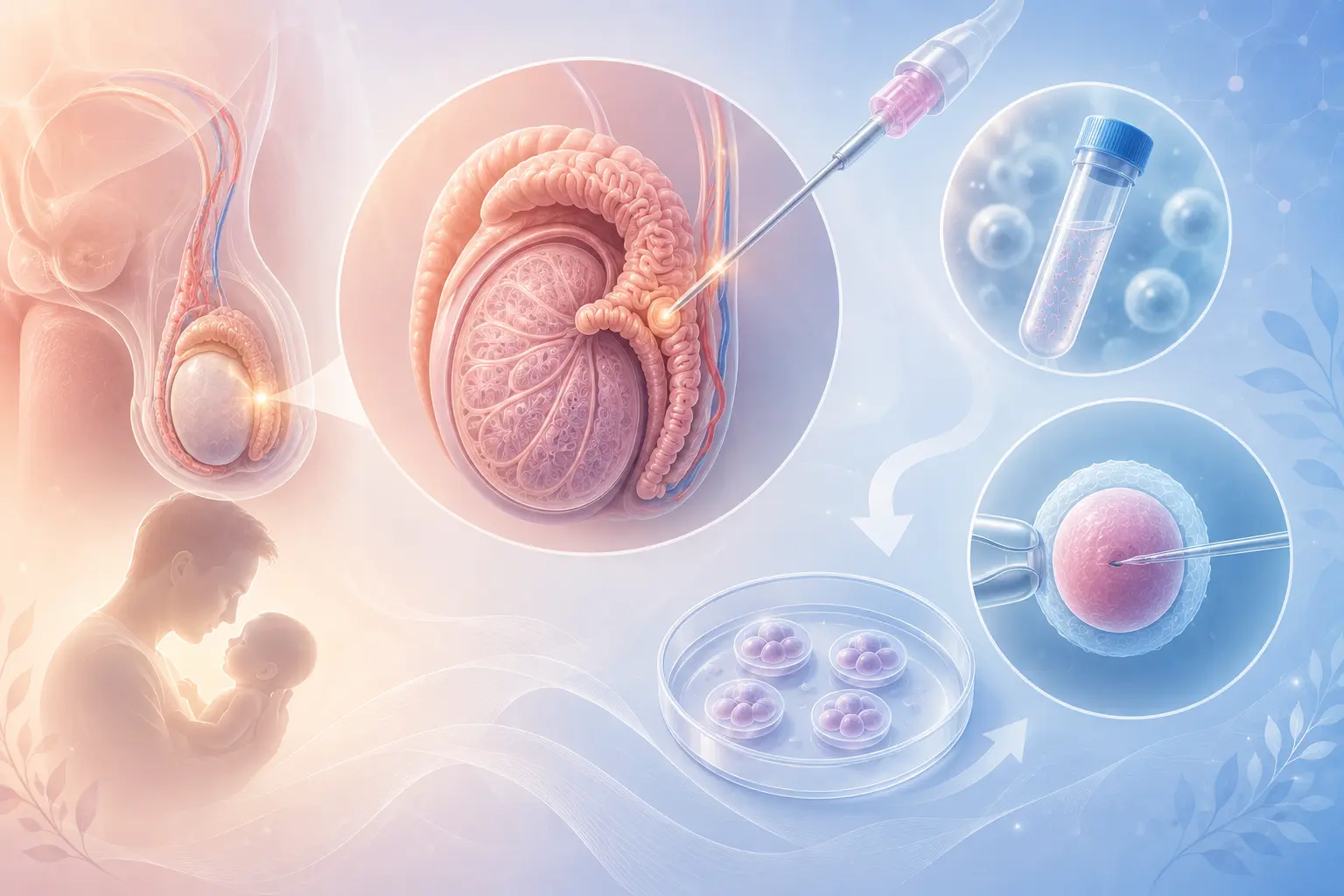
To understand how it works, it helps to know a little about male anatomy. Sperm is produced in the testes and then travels to a small coiled tube called the epididymis, where it matures and is stored before ejaculation. In some men, a blockage somewhere along this path prevents sperm from reaching the ejaculate. The sperm exists. It just cannot get out.
Think of it like a blocked pipe. The water is there, but the blockage stops it from flowing through. PESA removes the blockage from the equation entirely by going directly to the source.
In PESA, a fine needle is inserted through the skin of the scrotum into the epididymis. Fluid is gently aspirated and examined under a microscope for the presence of sperm. If sperm is found, it is collected, processed, and used for ICSI on the same day or frozen for future use.
The procedure is done under local anaesthesia or mild sedation. It takes 15 to 30 minutes. Most men return to normal activities within a day or two.
What is the Difference Between PESA, TESA, and MESA?
Sperm retrieval is not a single procedure. Different techniques are used depending on the cause of the sperm problem and where in the reproductive tract sperm is most likely to be found.
PESA (Percutaneous Epididymal Sperm Aspiration): A fine needle is inserted through the skin into the epididymis to aspirate sperm. It is minimally invasive, does not require a surgical incision, and is typically the first retrieval method attempted when a blockage is the cause. It is best suited for men with obstructive azoospermia.
TESA (Testicular Sperm Aspiration): A fine needle is inserted directly into the testis to aspirate sperm and tissue. It is used when PESA does not yield enough sperm or when the cause is testicular rather than obstructive. It is also used in men with non-obstructive azoospermia, where sperm production is reduced.
MESA (Microsurgical Epididymal Sperm Aspiration): A microsurgical procedure performed under an operating microscope to carefully open the epididymis and collect sperm. It typically yields a larger quantity of sperm than PESA and is preferred when a large quantity needs to be banked for multiple ICSI cycles. It requires a more experienced surgical team.
At Delhi IVF, all three procedures are available. Your specialist will recommend the most appropriate technique based on your semen analysis results, hormone levels, testicular ultrasound, and the likely cause of azoospermia.
Who is PESA Recommended For?
PESA is specifically recommended for men with obstructive azoospermia. This means no sperm is present in the ejaculate because of a physical blockage, not because the testes have stopped producing sperm.
Common Causes of Obstructive Azoospermia
Vasectomy: Men who have had a vasectomy and now wish to father a biological child are ideal candidates for PESA. Rather than a vasectomy reversal, which has variable success rates, PESA retrieves sperm directly and uses it with ICSI.
Congenital Absence of the Vas Deferens (CBAVD): Some men are born without the vas deferens, the tube that carries sperm from the epididymis to the ejaculate. This is often associated with cystic fibrosis gene mutations. The testes produce sperm normally, but there is no pathway for it to exit. PESA retrieves sperm directly from the epididymis.
Previous Infection or Injury: Infections such as epididymitis or sexually transmitted infections can cause scarring that blocks the reproductive tract. Physical injury or previous surgery in the area can also cause blockages. PESA retrieves sperm from above the blockage site.
Failed Vasectomy Reversal: Some men have undergone vasectomy reversal that did not restore sperm to the ejaculate. PESA is an effective option in these cases, bypassing the site of failed reversal entirely.
When PESA May Not Be the Right Procedure
PESA is not appropriate for non-obstructive azoospermia, where the testes are not producing sperm at all or producing very few. In these cases, TESA or surgical testicular biopsy (TESE) is used to search for sperm directly within testicular tissue. Your specialist at Delhi IVF will determine which applies to you through hormone testing, testicular ultrasound, and, in some cases, a diagnostic testicular biopsy.
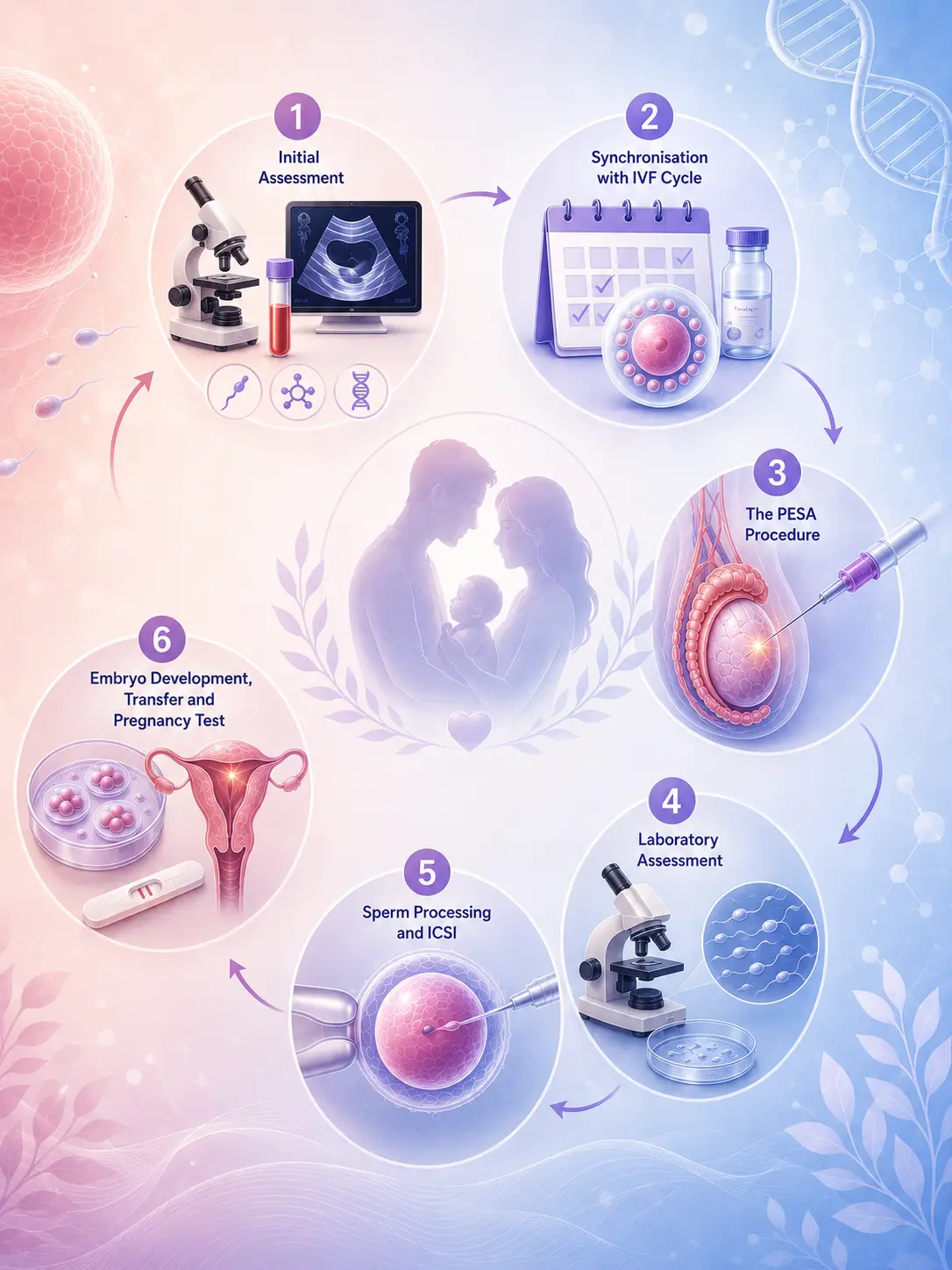
The PESA Process at Delhi IVF: Step by Step
Step 1: Initial Assessment
Your first appointment includes a detailed semen analysis review, hormone blood tests (FSH, LH, testosterone, prolactin), scrotal ultrasound, and a full medical history. These investigations help determine whether azoospermia is obstructive or non-obstructive and which retrieval method is most likely to succeed. Genetic testing, such as karyotype and Y-chromosome microdeletion analysis, may also be recommended.
Step 2: Synchronisation with the Female Partner's IVF Cycle
PESA is coordinated with the female partner's IVF cycle so that retrieved sperm can be used fresh on the day of egg retrieval. Alternatively, sperm can be retrieved in advance and frozen for use in a future ICSI cycle. Your specialist at Delhi IVF will advise the most practical approach based on your situation.
Step 3: The PESA Procedure
The procedure is performed under local anaesthesia or mild sedation as a day procedure. A fine needle is inserted through the scrotal skin into the epididymis. Fluid is gently aspirated and passed immediately to our embryology team in the adjacent laboratory.
Step 4: Laboratory Assessment
Our embryology team examines the aspirated fluid under a microscope in real time. If motile sperm are identified, the sample is processed for use with ICSI. If the initial aspiration does not yield sufficient sperm, the procedure may be repeated at a slightly different location, or TESA may be attempted in the same sitting.
Step 5: Sperm Processing and ICSI
Retrieved sperm is prepared and used for ICSI alongside the eggs retrieved from the female partner. A single sperm is injected into each mature egg. Fertilisation results are confirmed the following morning.
Step 6: Embryo Development, Transfer, and Pregnancy Test
Fertilised eggs develop into embryos over three to five days. The best quality embryo is selected for transfer. The pregnancy blood test is done 14 days after the transfer.
Advanced PESA Treatment in India
PESA is an effective solution for men with obstructive azoospermia caused by vasectomy, congenital absence of the vas deferens, or blockage due to infection or injury. The procedure takes only a short time, involves minimal discomfort, and allows retrieved sperm to be used immediately with ICSI or frozen for future use. For many couples, it provides a realistic and highly successful path to biological parenthood.
Speak With Our Fertility Team: +91-9810600235
PESA Success Rates
The success of PESA depends on two factors: whether sperm is successfully retrieved, and then the success of the subsequent ICSI cycle.
Sperm retrieval rate: In men with confirmed obstructive azoospermia, PESA successfully retrieves sperm in approximately 80% to 90% of cases. The higher the likelihood of obstruction being the cause, the higher the retrieval success rate.
ICSI success rate after PESA: Once sperm is successfully retrieved, the overall pregnancy rate per ICSI cycle follows standard IVF success rates based on the female partner's age and embryo quality: approximately 40% to 50% per cycle for women under 35, declining with age.
If PESA does not retrieve sperm in the first attempt, TESA or TESE can be performed in the same sitting or in a separate procedure.
PESA Cost in India
In India, PESA is typically performed as part of an overall ICSI treatment package. The procedure itself usually costs between Rs 15,000 and Rs 35,000 as an additional charge to the base IVF and ICSI cycle cost.
If TESA or MESA is needed alongside, additional costs apply. At Delhi IVF, all costs are discussed clearly before your procedure day.
Real Families. Real Stories.
Our Team
Meet the specialists behind your baby dream
Senior IVF consultants, embryologists and gynaecologists working as one team.

Dr. Anoop Gupta
Director & IVF Specialist, Delhi IVF & Fertility Research Centre

Dr. Aastha Gupta
Infertility Specialist, Obs & Gynae (Gold Medalist)

Mrs. Alka Gupta
Chief Embryologist, Delhi IVF & Fertility Research Centre

Dr. Mannan Gupta
MBBS & MS – Obstetrics & Gynaecology, Maulana Azad Medical College

Why Patients Choose Delhi IVF for PESA
At Delhi IVF and Fertility Research Centre, couples receive advanced care for male infertility and azoospermia through a comprehensive fertility programme designed to maximise the chances of successful sperm retrieval and pregnancy. Our centre offers all major surgical sperm retrieval techniques under one roof, allowing treatment to be tailored to the exact cause of obstructive or non-obstructive azoospermia. With a highly experienced embryology laboratory, coordinated IVF and ICSI services, and a strong track record since 1993, Delhi IVF is a trusted destination for couples from India and around the world.
What Patients Experience at Delhi IVF
- Complete male fertility programme including PESA, TESA, MESA, and TESE under one roof
- Coordinated same-day sperm retrieval and ICSI for maximum efficiency
- Sperm freezing and long-term storage for future treatment cycles
- 25,000+ successful deliveries since 1993
- Patients from 66+ countries seeking advanced fertility care
- Transparent treatment planning and pricing with no hidden surprises
- Personalised recommendations on whether PESA, TESA, MESA, or TESE is most suitable for your case
If you have been diagnosed with zero sperm count or obstructive azoospermia, Delhi IVF offers advanced technology, expert laboratory support, and compassionate care to help you pursue biological parenthood with confidence.
Our Success Stories
25000 Happy Couples with real stories from Delhi IVF Patients,

What our patient's are saying
I am so happy to share that my IVF result came positive. Thank you Delhi IVF and Dr Anoop Gupta and Dr Aastha Gupta. The team here is amazing very professional, kind and encouraging. Thank you for giving us hope and happiness truly the best clinic for IVF.
Started with great first initial virtual with Dr Anoop Gupta ,Dr Aastha and team especially Beautiful Preeti ,explained everything perfectly with clear cost of treatment and services provided .Managed to come to the Centre from London in December greeted with nice supportive staff team ,as we had limited time ,all the tests and treatment started quite quickly and continued nicely till the end of.Very impressive experience to be here and feel blessed already Thank you for everything
Delhi IVF is the most trusted place, Dr. Anoop Gupta and team, as well as all the staffs are very kind and knowledgeable. Thank you! I got pregnant at first try. I am very happy now. I don't get word to express my feelings and how thankful I am for all Delhi IVF Doctors and staffs.Thank you again.
We are so happy to share that after trying from 11 years we conceived from Delhi IVF in first cycle I am very happy I work in TV9 as a journalist and I came here through reference and then first IVF successful with twins I will recommend everyone to come here for any problem with conceiving.
Today was my first visit to Delhi IVF centre in srinagar and i felt very good after coming here.The treatment was excellent.I want to tell everyone that if there is any good IVF centre in kashmir.it is only one Delhi IVF centre where Dr.Anoop Gupta provides treatment thank you so much.
My partner and I highly recommend the Dr. Anoop Gupta & his clinic Delhi IVF & fertility centre!!! Our experience was absolutely fantastic; the nurses are very kind, helpful and extremely talented across the whole range from doctors, nurses, and administrators.
I am very happy and my experience with Delhi IVF center is very nice. Now I'll get my 2 baby from the treatment in Delhi IVF. Very good and helpful staff. And I have no words for Dr. Anoop Gupta, he is very kind and well caring.Thank you Dr. Gupta and all staff members.
It's an amazing IVF centre, all doctors and staff are very supportive. We have been trying since a very long time, finally got success, all thanks to Delhi IVF.
Very good experience after visiting and meeting with Dr. Anoop gupta ji and his team. Before visiting here we had lost all hopes of conceiving baby but here we got confidance again and successfully gives birth to beautiful princess.
I am short of words when it comes to thanking Delhi IVF for what it has given me. I had been trying for 8 yrs and this clinic has given me the best gift ever. The team of doctors led by Dr Gupta and Dr Vinny are very helpful and caring.
Dr Gupta is an amazing doctor. I strongly advise to all friends and family who are struggling to become parents. You are assured to have a very satisfying experience and you could faith him fully to make the best result for you.
I am very happy with my wife by listening news of getting 2 babies in womb after ultrasound. Some time ago we were panicked but now we are very happy. Its a great news for us. We are thankful to Delhi IVF & Fertility Centre.
I am so happy to share that my IVF result came positive. Thank you Delhi IVF and Dr Anoop Gupta and Dr Aastha Gupta. The team here is amazing very professional, kind and encouraging. Thank you for giving us hope and happiness truly the best clinic for IVF.
Frequently Asked Questions
Q1: What is PESA treatment, and how does it work?
PESA (Percutaneous Epididymal Sperm Aspiration) retrieves sperm directly from the epididymis using a fine needle inserted through the scrotal skin. It is used for men with obstructive azoospermia where sperm is present but cannot reach the ejaculate. Retrieved sperm is used with ICSI to fertilise eggs.
Q2: What is the difference between PESA, TESA, and MESA?
PESA aspirates sperm from the epididymis using a fine needle. TESA aspirates sperm directly from the testis. MESA uses microsurgery to open the epididymis and collect a larger sperm sample. The right procedure depends on the cause of azoospermia. Your specialist at Delhi IVF advises based on your investigations.
Q3: How much does PESA treatment cost in India?
PESA in India typically costs between Rs 15,000 and Rs 35,000 as an addition to the base ICSI cycle. Total treatment cost includes the IVF and ICSI cycle for the female partner, sperm retrieval, laboratory processing, and embryo transfer. Delhi IVF provides transparent pricing before your procedure begins.
Q4: Is PESA successful for men with zero sperm count?
Yes, for men with obstructive azoospermia. When no sperm appear in the ejaculate due to a blockage, PESA retrieves sperm directly from the epididymis with a success rate of approximately 80% to 90% in confirmed obstructive cases. Retrieved sperm is then used with ICSI for fertilisation.
Q5: Can PESA be used after a vasectomy?
Yes. PESA is one of the most effective options for men who have had a vasectomy. It bypasses the vasectomy site entirely by retrieving sperm directly from the epididymis. It is often preferred over vasectomy reversal, particularly for older vasectomies, due to more predictable outcomes when combined with ICSI.
Q6: Is PESA a painful procedure?
PESA is performed under local anaesthesia or mild sedation, so discomfort during the procedure is minimal. Most men experience mild scrotal aching or tenderness for one to two days afterwards. Over-the-counter pain relief is usually sufficient, and most men return to normal activities within two days.
Q7: What happens if PESA does not retrieve any sperm?
If PESA does not find sperm, TESA can be attempted in the same sitting by aspirating from the testis itself. If neither procedure retrieves sufficient sperm, a surgical TESE procedure may be arranged. Your specialist at Delhi IVF will guide you through each step based on the findings during the procedure.
Q8: Can sperm retrieved through PESA be frozen for future use?
Yes. Sperm retrieved through PESA that is not used in the current cycle can be frozen and stored for future ICSI cycles. This avoids the need to repeat the retrieval procedure and provides a reliable backup for subsequent treatment attempts if the first transfer is unsuccessful.
Q9: Is PESA suitable for non-obstructive azoospermia?
No. PESA is designed for obstructive azoospermia, where a physical blockage prevents sperm from reaching the ejaculate. For non-obstructive azoospermia, where sperm production itself is reduced or absent, TESA or surgical TESE are more appropriate. Your Delhi IVF specialist will determine which type applies through hormone tests and ultrasound.
Q10: How long does recovery take after PESA?
Most men recover within one to two days after PESA. Mild scrotal discomfort and minor swelling are normal and settle quickly. Strenuous physical activity and sexual intercourse should be avoided for five to seven days. Your specialist at Delhi IVF will give you specific post-procedure care instructions before you go home.

Take the Next Step Toward Biological Parenthood
If you have been told that your semen analysis shows zero sperm count, there may still be an excellent chance of finding sperm through PESA. This quick, minimally invasive procedure bypasses the blockage and retrieves sperm directly from the epididymis, allowing couples to conceive through ICSI. With expert fertility care and advanced laboratory support, many men with azoospermia can father healthy biological children.
Call +91-9810600235