Genetic Screening for IVF in India: Expert Embryo Testing at Delhi IVF and Fertility Research Centre

Genetic screening in IVF is one of the most significant advances in reproductive medicine because it allows doctors to look beyond how an embryo appears under the microscope and evaluate whether it is chromosomally normal. Many embryos that look excellent in the laboratory may still carry genetic abnormalities that prevent implantation or lead to miscarriage. By identifying the healthiest embryos before transfer, genetic screening helps improve the chances of a successful pregnancy and reduces the emotional and financial burden of repeated failed IVF cycles.

At Delhi IVF and Fertility Research Centre, advanced embryo genetic testing is offered to couples who have experienced recurrent miscarriage, repeated IVF failure, advanced maternal age, or a known inherited genetic condition. With more than 34 years of experience, 25,000+ successful deliveries, and a highly skilled embryology team led by Mrs. Alka Gupta, our centre combines world-class IVF technology with expert interpretation to help patients make informed decisions and move forward with greater confidence.

Whether you are trying to avoid passing on a hereditary condition such as thalassaemia or simply want to improve the likelihood of selecting the best embryo for transfer, genetic screening can be a powerful part of your fertility treatment plan. In this guide, we explain the different types of embryo testing, who should consider them, the step-by-step process, costs in India, and how Delhi IVF helps couples achieve healthier pregnancies through precision reproductive medicine.

CTA Block Background Image - 6a05d251ff967f77638578ad

Improve IVF Success with Genetic Screening

Select the Healthiest Embryo Before Transfer

Repeated IVF failures and miscarriages are often caused by hidden chromosomal abnormalities. Advanced genetic screening at Delhi IVF helps identify chromosomally normal embryos, improving implantation rates and reducing miscarriage risk.

Call Now: +91-9810600235

What is Genetic Screening in IVF?

Genetic screening in IVF refers to testing embryos for chromosomal or genetic abnormalities before they are transferred into the uterus. The goal is simple: identify the embryo most likely to result in a healthy, successful pregnancy and transfer that embryo.

Think of it like quality checking before installation. Instead of placing an embryo and hoping it is chromosomally normal, genetic screening confirms it first.

There are two main types used in IVF today.

PGT-A: Preimplantation Genetic Testing for Aneuploidies

PGT-A screens embryos for chromosomal number abnormalities. A normal embryo has 46 chromosomes. When an embryo has too many or too few, it is called aneuploid. Most aneuploid embryos fail to implant, cause miscarriage, or lead to conditions such as Down syndrome.

PGT-A identifies which embryos are chromosomally normal (euploid) and which are not. Only euploid embryos are selected for transfer, significantly improving the chances of a successful pregnancy.

PGT-M: Preimplantation Genetic Testing for Monogenic Disorders

PGT-M tests embryos for specific inherited single-gene disorders. It is used when one or both parents carry a known genetic condition that could be passed to the child. Examples include sickle cell anaemia, thalassaemia, cystic fibrosis, spinal muscular atrophy, and Huntington's disease.

PGT-M allows families with a known genetic condition to have biological children without passing that condition on. It is a meaningful option for couples who carry a known disorder or have previously lost a child to one.

PGT-SR: Preimplantation Genetic Testing for Structural Rearrangements

PGT-SR is used when one parent carries a chromosomal structural rearrangement, such as a balanced translocation. These rearrangements may not affect the parent but can cause miscarriage or chromosomal problems in the embryo. PGT-SR screens embryos to identify those unaffected by the rearrangement.

Who Should Consider Genetic Screening?

At Delhi IVF, genetic screening is recommended in specific clinical situations where it is most likely to improve outcomes.

Women Over 35

Chromosomal abnormalities in embryos become significantly more common with age. Think of it like this: a woman under 30 produces roughly 20% to 30% abnormal embryos. A woman over 40 may produce 70% to 80% abnormal embryos. PGT-A helps identify the normal ones quickly, reducing the number of failed transfers and the time to a successful pregnancy.

Couples with Repeated Implantation Failure

If you have had two or more IVF cycles with good quality embryos that did not implant, chromosomal abnormality in the embryo is one of the most common explanations. PGT-A can identify whether this is a contributing factor and select only normal embryos for the next transfer.

Couples with Recurrent Pregnancy Loss

Two or more miscarriages are emotionally devastating. In the majority of cases, early miscarriage is caused by a chromosomal abnormality in the embryo. PGT-A reduces miscarriage rates by ensuring only chromosomally normal embryos are transferred, giving each pregnancy a significantly better chance of continuing.

Carriers of Inherited Genetic Conditions

If you or your partner carries a known genetic condition such as thalassaemia, sickle cell disease, cystic fibrosis, or a chromosomal translocation, PGT-M or PGT-SR can test embryos before transfer. This prevents the condition from being passed on.

Couples with a History of a Child with a Genetic Condition

If a previous pregnancy was affected by a genetic condition, screening in the next IVF cycle helps prevent recurrence.

Men with Severe Male Factor Infertility

Severe male factor infertility is sometimes linked to higher chromosomal abnormality rates in sperm. PGT-A can screen the resulting embryos before transfer.

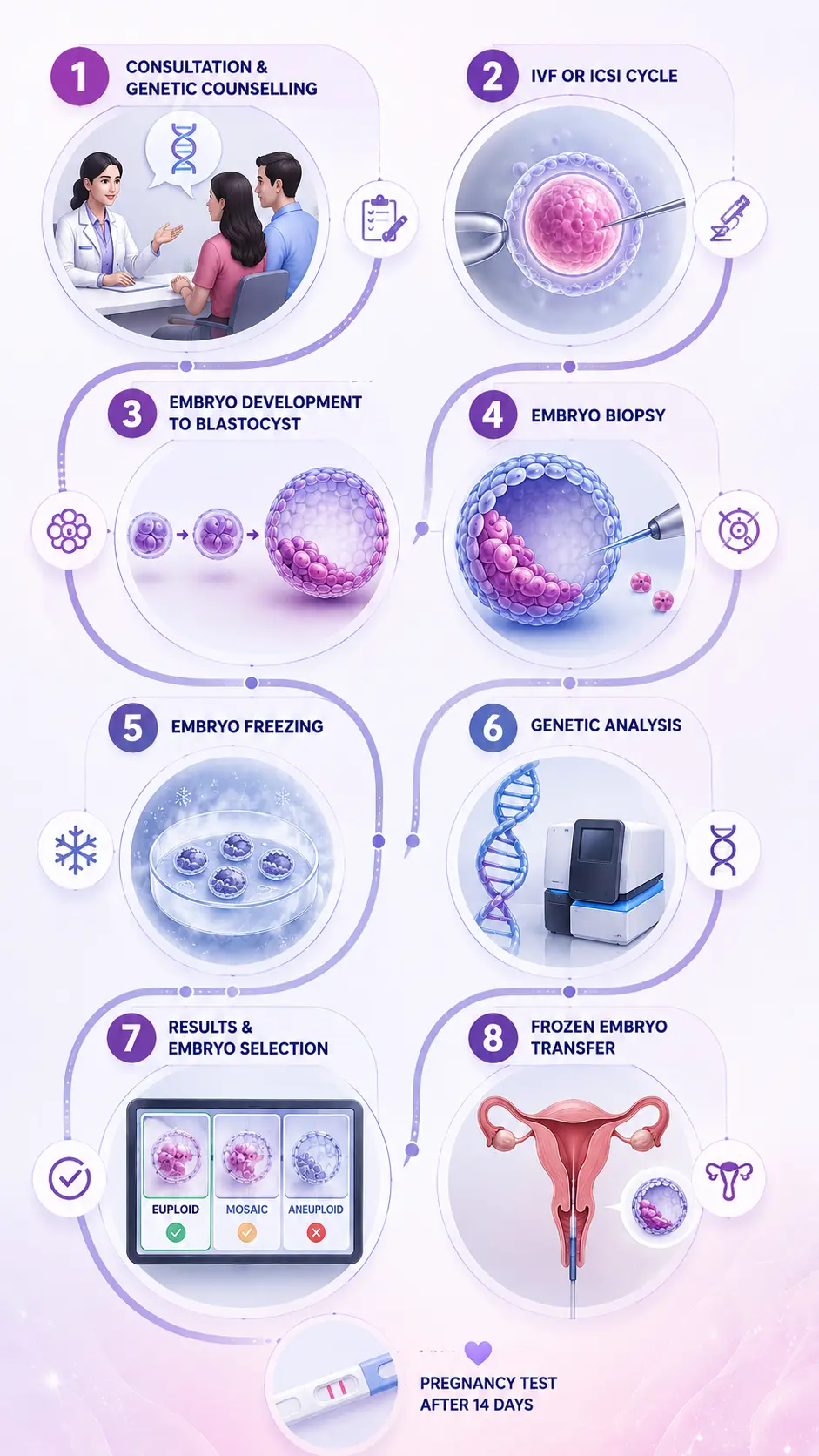
The Genetic Screening Process at Delhi IVF: Step by Step

Step 1: Consultation and Genetic Counselling

Before genetic screening is recommended, your specialist at Delhi IVF will review your medical history, previous cycle outcomes, and any known family genetic conditions. For PGT-M, a genetic counsellor designs a custom test probe for your family's specific condition. This preparation takes a few weeks before the IVF cycle begins.

Step 2: IVF or ICSI Cycle

Genetic screening is performed alongside a standard IVF or ICSI cycle. The ovarian stimulation, egg retrieval, and fertilisation process follows the same steps as a regular IVF cycle. The difference happens at the embryo stage.

Step 3: Embryo Development to Blastocyst

Embryos are cultured in the laboratory for five to six days until they reach the blastocyst stage. Blastocyst biopsy is more accurate and less risky than biopsying at an earlier stage. A healthy blastocyst contains around 100 to 200 cells, and the few cells removed for testing do not affect the embryo's development.

Step 4: Embryo Biopsy

A small number of cells, typically five to eight, are gently removed from the outer layer of the blastocyst called the trophectoderm. This outer layer forms the placenta, not the baby itself. Removing cells from this layer does not affect the inner cell mass that develops into the baby.

The biopsy is performed by our embryology team using a laser for precise, safe cell removal. The process takes a few minutes per embryo.

Step 5: Embryo Freezing

After biopsy, all embryos are immediately frozen using vitrification while the genetic results are awaited. This is called a freeze-all cycle. No fresh transfer is done in the same cycle as the biopsy.

Step 6: Genetic Analysis

The biopsied cells are sent to a specialist genetics laboratory for analysis. Results typically take seven to ten days for PGT-A. PGT-M results may take longer depending on the complexity of the condition being tested.

Step 7: Results and Embryo Selection

Results are reviewed by your specialist at Delhi IVF. Embryos are classified as euploid (normal), aneuploid (abnormal), or mosaic (a mix of normal and abnormal cells). Your specialist discusses the results with you and advises which embryo or embryos are suitable for transfer.

Step 8: Frozen Embryo Transfer

The selected chromosomally normal embryo is thawed and transferred into the uterus in a subsequent frozen embryo transfer cycle. A pregnancy test is done 14 days later.

Content Block Image - 6a05d3e4ff967f77638578ce
CTA Block Background Image - 6a05d251ff967f77638578ad

Prevent Inherited Genetic Disorders

Protect Your Future Baby from Hereditary Conditions

If you or your partner carries conditions such as thalassaemia, sickle cell disease, or other inherited disorders, PGT-M can help you conceive a healthy biological child without passing on the condition.

Speak with Our IVF & Genetics Experts: +91-9810600235

Does Genetic Screening Improve IVF Success Rates?

For the right patients, genetic screening meaningfully improves outcomes.

For women over 38, PGT-A reduces the number of failed transfers significantly by ensuring only chromosomally normal embryos are used. This improves the pregnancy rate per transfer and reduces the time spent on unsuccessful cycles.

For couples with recurrent miscarriage, PGT-A reduces miscarriage rates from approximately 25% to 30% per transfer down to around 10% when only euploid embryos are transferred.

For couples with a known genetic condition, PGT-M virtually eliminates the risk of passing that specific condition to the child.

It is important to understand that genetic screening does not create more normal embryos. It identifies which embryos are already normal from those available. If all embryos from a cycle are aneuploid, there is no euploid embryo to transfer. This outcome, though difficult, is important information that guides the next clinical decision.

Genetic Screening Cost in India

Genetic screening is an additional cost on top of the base IVF cycle. In India, costs vary depending on the type of test and the number of embryos being screened.

PGT-A cost in India: Typically ranges from Rs 50,000 to Rs 1,20,000 for screening up to eight embryos, including biopsy, genetic analysis, and reporting.

PGT-M cost in India: More expensive than PGT-A due to the need for a custom probe designed for your specific genetic condition. Costs typically range from Rs 80,000 to Rs 2,00,000 depending on the complexity of the disorder.

These costs do not include the frozen embryo transfer cycle. At Delhi IVF, all costs are explained clearly before you begin.

Real Families. Real Stories.

Our Team

Meet the specialists behind your baby dream

Senior IVF consultants, embryologists and gynaecologists working as one team.

Browse All Our Specialists
Dr. Anoop Gupta

Dr. Anoop Gupta

Director & IVF Specialist, Delhi IVF & Fertility Research Centre

⭐34+ Years Experience
View Profile
Dr. Aastha Gupta

Dr. Aastha Gupta

Infertility Specialist, Obs & Gynae (Gold Medalist)

⭐15+ Years Experience
View Profile
Mrs. Alka Gupta

Mrs. Alka Gupta

Chief Embryologist, Delhi IVF & Fertility Research Centre

⭐32+ Years Experience
View Profile
Dr. Mannan Gupta

Dr. Mannan Gupta

MBBS & MS – Obstetrics & Gynaecology, Maulana Azad Medical College

⭐10+ Years Experience
View Profile
Dr. Vinnie Sandhu

Dr. Vinnie Sandhu

MD (Moscow), Obstetrics & Gynaecology

⭐30+ Years Experience
View Profile

Why Patients Choose Delhi IVF for Genetic Screening

Delhi IVF and Fertility Research Centre is trusted by couples across India and from more than 66 countries for advanced genetic screening and embryo testing. Our centre combines decades of fertility expertise with state-of-the-art embryology and genetics support to help identify the healthiest embryos for transfer. Every step of the process - from embryo biopsy to genetic analysis and result interpretation—is handled with precision, transparency, and a strong focus on improving your chances of a healthy pregnancy.

We understand that genetic screening is often chosen after repeated IVF failures, miscarriages, or concerns about inherited disorders. That is why we provide clear counselling, accurate laboratory processes, and honest guidance based on your individual results. Whether your embryos are found to be euploid, mosaic, or aneuploid, our team explains what the findings mean and helps you make confident decisions about the next steps in your fertility journey.

What Our Patients Experience at Delhi IVF

  1. Advanced embryo biopsy technology with precise and safe cell removal
  2. Partnerships with accredited genetics laboratories for highly accurate testing
  3. Comprehensive genetic counselling support for couples undergoing PGT-M
  4. More than 25,000 successful deliveries since 1993
  5. Patients from 66+ countries seeking expert fertility and genetic screening care
  6. Transparent result interpretation with honest recommendations
  7. Personalised treatment plans based on your medical and genetic profile
  8. International standards in IVF laboratory and embryo handling
  9. Dedicated support throughout every stage of treatment
  10. A compassionate team focused on helping you achieve a healthy pregnancy

Our Success Stories

25000 Happy Couples with real stories from Delhi IVF Patients,

google logo
4.5
/5
Based on 1000+ reviews

What our patient's are saying

Updated recently • Verified reviews

I am very happy with my wife by listening news of getting 2 babies in womb after ultrasound. Some time ago we were panicked but now we are very happy. Its a great news for us. We are thankful to Delhi IVF & Fertility Centre.

Manish Gupta
IVF with ICSI

I am so happy to share that my IVF result came positive. Thank you Delhi IVF and Dr Anoop Gupta and Dr Aastha Gupta. The team here is amazing very professional, kind and encouraging. Thank you for giving us hope and happiness truly the best clinic for IVF.

Deepa Kumari
IVF with ICSI

Started with great first initial virtual with Dr Anoop Gupta ,Dr Aastha and team especially Beautiful Preeti ,explained everything perfectly with clear cost of treatment and services provided .Managed to come to the Centre from London in December greeted with nice supportive staff team ,as we had limited time ,all the tests and treatment started quite quickly and continued nicely till the end of.Very impressive experience to be here and feel blessed already Thank you for everything

Navneet Kaur
IUI Procedure

Delhi IVF is the most trusted place, Dr. Anoop Gupta and team, as well as all the staffs are very kind and knowledgeable. Thank you! I got pregnant at first try. I am very happy now. I don't get word to express my feelings and how thankful I am for all Delhi IVF Doctors and staffs.Thank you again.

Angle Thar
Egg Freezing

We are so happy to share that after trying from 11 years we conceived from Delhi IVF in first cycle I am very happy I work in TV9 as a journalist and I came here through reference and then first IVF successful with twins I will recommend everyone to come here for any problem with conceiving.

Rohit Nirwal
IVF with ICSI

Today was my first visit to Delhi IVF centre in srinagar and i felt very good after coming here.The treatment was excellent.I want to tell everyone that if there is any good IVF centre in kashmir.it is only one Delhi IVF centre where Dr.Anoop Gupta provides treatment thank you so much.

Manzoor Paul
IVF with ICSI

My partner and I highly recommend the Dr. Anoop Gupta & his clinic Delhi IVF & fertility centre!!! Our experience was absolutely fantastic; the nurses are very kind, helpful and extremely talented across the whole range from doctors, nurses, and administrators.

Baabul Kumar
IVF with ICSI

I am very happy and my experience with Delhi IVF center is very nice. Now I'll get my 2 baby from the treatment in Delhi IVF. Very good and helpful staff. And I have no words for Dr. Anoop Gupta, he is very kind and well caring.Thank you Dr. Gupta and all staff members.

Ravi Prakash
IVF with ICSI

It's an amazing IVF centre, all doctors and staff are very supportive. We have been trying since a very long time, finally got success, all thanks to Delhi IVF.

Kundan Sinha
Egg Freezing

Very good experience after visiting and meeting with Dr. Anoop gupta ji and his team. Before visiting here we had lost all hopes of conceiving baby but here we got confidance again and successfully gives birth to beautiful princess.

Dinesh Chauhan
IVF with ICSI

I am short of words when it comes to thanking Delhi IVF for what it has given me. I had been trying for 8 yrs and this clinic has given me the best gift ever. The team of doctors led by Dr Gupta and Dr Vinny are very helpful and caring.

Anubha Singh
IVF with ICSI

Dr Gupta is an amazing doctor. I strongly advise to all friends and family who are struggling to become parents. You are assured to have a very satisfying experience and you could faith him fully to make the best result for you.

Rohit Lakra
IVF with ICSI

I am very happy with my wife by listening news of getting 2 babies in womb after ultrasound. Some time ago we were panicked but now we are very happy. Its a great news for us. We are thankful to Delhi IVF & Fertility Centre.

Manish Gupta
IVF with ICSI

I am so happy to share that my IVF result came positive. Thank you Delhi IVF and Dr Anoop Gupta and Dr Aastha Gupta. The team here is amazing very professional, kind and encouraging. Thank you for giving us hope and happiness truly the best clinic for IVF.

Deepa Kumari
IVF with ICSI

Frequently Asked Questions

Q1: What is PGT-A genetic screening in IVF, and who needs it?

PGT-A screens embryos for chromosomal number abnormalities before transfer. It is recommended for women over 35, couples with repeated IVF failure, recurrent miscarriage, or severe male factor infertility. Only chromosomally normal embryos are selected for transfer, improving success rates and reducing miscarriage risk significantly.

Q2: How much does genetic screening cost in IVF in India?

PGT-A in India typically costs Rs 50,000 to Rs 1,20,000 for up to eight embryos, including biopsy and genetic analysis. PGT-M for inherited conditions costs Rs 80,000 to Rs 2,00,000 due to custom probe design. These costs are in addition to the base IVF cycle at Delhi IVF.

Q3: Can genetic screening prevent miscarriage in IVF?

Yes. Most early miscarriages are caused by chromosomal abnormalities in the embryo. PGT-A screens embryos before transfer and selects only chromosomally normal ones. Studies show miscarriage rates drop from around 25% to 30% per transfer to approximately 10% when only euploid embryos are transferred.

Q4: What is the difference between PGT-A, PGT-M, and PGT-SR?

PGT-A screens for chromosomal number abnormalities. PGT-M tests for specific inherited single-gene disorders such as thalassaemia or cystic fibrosis. PGT-SR is used when a parent carries a chromosomal structural rearrangement. Your specialist at Delhi IVF will advise which type is appropriate for your situation.

Q5: Is embryo biopsy for genetic screening safe?

Yes. Cells are taken from the outer layer of the blastocyst, which forms the placenta, not the baby. Research consistently shows no difference in outcomes between biopsied and non-biopsied embryos. At Delhi IVF, biopsy is performed by our senior embryology team using a precise laser-assisted technique.

Q6: Can genetic screening help couples with thalassaemia or sickle cell disease?

Yes. PGT-M is specifically designed for couples who carry inherited conditions like thalassaemia, sickle cell disease, or cystic fibrosis. A custom genetic probe is created for your family's specific mutation. Only unaffected embryos are transferred, preventing the condition from being passed to the child.

Q7: What happens if all embryos are genetically abnormal after PGT-A?

If all tested embryos are aneuploid, there is no normal embryo available for transfer in that cycle. Your specialist at Delhi IVF will discuss the next steps, which may include a further stimulation cycle, using donor eggs, or, in select cases, transferring a mosaic embryo with careful counselling and monitoring.

Q8: Does genetic screening guarantee a successful IVF pregnancy?

No. Genetic screening significantly improves the chances of successful implantation and reduces miscarriage risk, but it does not guarantee pregnancy. It cannot screen for all possible conditions and does not overcome other barriers to implantation. It is one powerful tool within a broader IVF treatment plan.

Q9: How long do PGT genetic screening results take in India? PGT-A results typically take seven to ten days after embryo biopsy. PGT-M results may take longer depending on the complexity of the condition being tested. All biopsied embryos are frozen safely at Delhi IVF while results are awaited, with the transfer done in a subsequent frozen cycle.

Q10: Is genetic screening recommended for a first IVF cycle in India?

Not always. For women under 35 with no history of miscarriage or genetic conditions, it is not routinely recommended for a first cycle. It is most valuable for women over 38, with repeated IVF failure, recurrent miscarriage, or known carrier status. Your Delhi IVF specialist will advise based on your individual profile.


CTA Block Background Image - 6a05d251ff967f77638578ad

Trusted IVF Genetic Testing in India

34+ Years of Fertility Expertise. 25,000+ Successful Deliveries.

Delhi IVF combines advanced embryo biopsy technology, accredited genetic laboratories, and decades of clinical experience to give you the best chance of a healthy pregnancy.

Call Delhi IVF Today: +91-9810600235